PublicationGod › AI peer review guide
What is AI peer review?
AI peer review means using an AI language model to assess a manuscript or proposal and produce review-style feedback: a summary, strengths and weaknesses, concerns and requested revisions. Two very different uses share this name.
- Pre-submission review. Authors run an AI review on their own manuscript before they submit it, as a mock review that finds weak spots early.
- AI-assisted reviewing. Reviewers or editors use AI while assessing someone else’s confidential work. Funders and publishers regulate this use tightly.
Most of the rules below concern the second use. PublicationGod’s AI review is built for the first.
What AI can and cannot do in peer review
| AI can help with | AI cannot replace |
|---|---|
| Spotting unclear structure, missing sections and claims that differ between abstract, results and discussion | Domain expertise and scientific judgement about significance |
| Flagging overclaiming, missing controls or statistics and thin methods descriptions | Checking raw data, code or experiments |
| Suggesting how to make an argument clearer, in the language of the manuscript | Complete knowledge of the current literature; novelty claims still need your own check |
| Catching avoidable problems cheaply before the real reviewers see the draft | Accountability, which always stays with the human |
The DFG guideline names three failure modes: errors and bias in generated text, a tendency to favour established approaches over novel ones (status quo bias), and automation bias, where coherent-sounding text is trusted too readily.
DFG guidelines on AI in peer review (Leitlinie zum Einsatz von KI im Begutachtungsprozess)
The German Research Foundation (DFG, Deutsche Forschungsgemeinschaft) changed its position on AI in the review process between 2023 and 2026. This is the timeline.
| Date | Document | Position |
|---|---|---|
| 21 Sep 2023 | Guidelines on generative models for text and image creation (Executive Committee statement) | Applicants disclose their use of generative models, only natural persons can be authors, and generative models may not be used to prepare reviews because review documents are confidential |
| Dec 2025 | Guideline on the Use of Artificial Intelligence in the Review Process, approved by the Main Committee (Hauptausschuss) | Approved after a reassessment between 2023 and 2025 |
| 12 Mar 2026 | Position paper and published guideline (form 4.04, version 03/26) | Documents the reassessment and sets out the conditions for AI use in review |
| 16 Apr 2026 | Guideline takes effect | Reviewers may use generative AI in a supporting role under four principles |
The change was not undisputed: some researchers criticized it, arguing that it undermines the autonomy of reviewers.
What the current guideline allows and prohibits
- Allowed: researching relevant literature, turning your own notes into full text when your assessment is already clear, and getting suggestions to improve the structure or language of your own ideas.
- Prohibited: letting AI generate substantial parts of a review automatically and without reflection; processing proposal content in cloud systems without contractually guaranteed data security; storing confidential material without control, using it for other purposes or using it to train AI.
The four principles
| Principle | What it requires |
|---|---|
| Confidentiality | Enter proposal content into an AI system only if the provider cannot keep it permanently or beyond the review. Accepted setups are a model running locally on your own device, a system hosted by a trustworthy institution such as a university, or a cloud service under a contract that guarantees data security and excludes any use of inputs, including training, with protective settings switched on |
| Transparency | State when you submit the review that you used AI, for which purposes and to what extent. A brief note is enough and passages need not be marked. Tools that do not affect content, such as grammar or translation tools, need not be disclosed |
| Quality assurance | Check, adapt and verify AI output for factual accuracy, currency and bias. Do not accept it uncritically |
| Responsibility | Reviewers stay fully responsible for the content of their review. Responsibility cannot be delegated to an AI system |
Passing confidential review content to unauthorized parties can count as scientific misconduct under the DFG’s procedural rules, which is why confidentiality matters most in practice.
Scope. The guideline applies to reviewers of DFG funding proposals. It does not govern journal peer review, and it does not describe how authors may use AI on their own manuscripts.
Rules for AI in journal peer review
Journals and publishers set their own rules, and they are often stricter than funders. Elsevier, for example, prohibits reviewers from uploading a manuscript or any part of it into a generative AI tool and says generative AI should not be used to assist in reviewing it, citing confidentiality and data privacy. Check the policy of the journal or funder before you use any AI tool on a document you were asked to review.
As an author you usually have to disclose AI use. Elsevier, for instance, requires a separate declaration above the reference list. The journal guides on this site summarize the AI rules of each journal they cover.
AI manuscript review with PublicationGod (pre-submission)
PublicationGod’s AI review gives authors a critical, structured read of their own manuscript before it goes to editors and reviewers. It works in two ways.
- Upload an existing PDF (presubmission feature). On the Review page you upload a finished PDF. Figures embedded in the PDF are visible to the model. This works for manuscripts written anywhere, not only in PublicationGod.
- Review inside your PublicationGod project. When title, abstract, introduction, methods, results and discussion are in place, the Export tab reviews your manuscript from those sections and the figure descriptions. Citations are treated as standard citations, and the review does not comment on reference formatting.
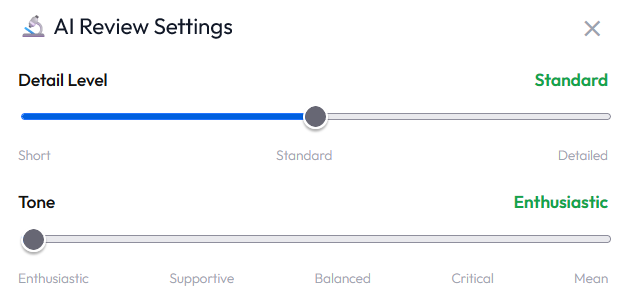
Settings
| Setting | Choices |
|---|---|
| Detail level | Short, Standard or Detailed |
| Tone | Enthusiastic, Supportive, Balanced, Critical or Mean, from encouraging to blunt |
| Language | The language of the manuscript |
What the review contains
- Title and a two-sentence summary of the study and its main finding.
- Assessment of novelty, originality, clinical relevance, robustness and innovation or methodology.
- Major concerns and minor concerns, each as a numbered list.
- Must-have revisions: what would be needed for publication.
- Nice-to-have additions: optional experiments or analyses (included in the Detailed setting).
The review is written as an experienced reviewer for high-impact journals would write it. The output is plain, editable text that you can copy or download as RTF.
Data protection
- The PDF is stored temporarily on a server in Germany and sent via HTTPS to Google Vertex AI in an EU region for processing.
- Input data is not used for AI training under the applicable API agreements.
- Uploaded files are deleted automatically after 30 minutes (hourly cleanup, at the latest within about 90 minutes).
- You confirm that you have the right to upload the document before you generate. The upload declaration links to the DFG position paper.
- Text inside a PDF that tries to instruct the AI, for example a request for a positive review, is treated as data, not followed, and flagged as an integrity concern in the review.
Cost. An AI review costs from 5,000 Credits, and the price is shown before you generate. No credit card is needed to register.
Using AI review responsibly
An AI review is a mock review for authors, not an official peer review.
- Treat it as a checklist. Use it to find weak spots early, then verify each point yourself. Generic or wrong criticism is possible.
- Never submit AI output as an official review. PublicationGod’s upload declaration requires independent expert assessment for that.
- Only upload what you may upload. That means your own manuscript, with the agreement of your co-authors.
- Follow funder and journal rules. If you are asked to review someone else’s manuscript or proposal, the rules of the funder or journal come first. Whether a tool meets their confidentiality conditions is for you and your institution to judge; the data handling above is documented so that you can assess it.
- Disclose AI use wherever the journal or funder requires it.
Get a structured AI review of your manuscript
Upload your PDF, choose depth and tone, and read the review in your browser. Check every point before you act on it.
Try an AI reviewNew here? Register for free. No credit card needed.
Frequently asked questions
Is AI peer review allowed?
It depends on who uses it and on whose document. Authors can run an AI review on their own manuscript before submission, subject to their journal’s disclosure rules. For peer reviewers, funders and journals decide: the DFG has allowed supporting use under conditions since April 2026, while Elsevier prohibits reviewers from uploading manuscripts into generative AI tools.
What do the DFG guidelines say about AI in peer review?
Since 16 April 2026, DFG reviewers may use generative AI in a supporting role if they respect four principles: confidentiality, transparency, quality assurance and responsibility. Generating substantial parts of a review automatically and without reflection is prohibited, as is processing proposal content in cloud systems without contractually guaranteed data security. In September 2023 the DFG had still excluded AI in review procedures.
Can AI replace human peer review?
No. The DFG limits AI to a supporting role and says responsibility cannot be passed on to an AI system. PublicationGod’s reviews are meant for authors preparing a submission, not as a substitute for expert assessment.
How reliable is an AI manuscript review?
It can surface real weaknesses such as unclear structure, overclaiming or missing controls, but it can also produce plausible-sounding mistakes or generic comments. The DFG warns about errors, bias and automation bias. Check every point against your data and your field.
Is my manuscript safe when I upload it?
You confirm that you have the right to upload the document before you generate a review. The PDF is stored temporarily on a server in Germany and sent via HTTPS to Google Vertex AI in an EU region. It is not used for AI training under the applicable API agreements and is deleted automatically after 30 minutes (hourly cleanup, at the latest within about 90 minutes).
How much does an AI review cost?
From 5,000 PublicationGod Credits. The price is shown before you generate. No credit card is needed to register.
Which language is the review written in?
In the language of your manuscript.
Can I also get a graphical abstract for the same PDF?
Yes. The same upload supports an AI-generated graphical abstract. See the graphical abstract guide, including journal policies on AI-generated images.
Related guides
- Graphical abstract: requirements, design tips and an AI generator
- Journal author guidelines, summarized
- Is AI use allowed? How PublicationGod handles disclosure